Loading

Loading
Quantum & Cyber / Airborne Integration
The gap between a laboratory result and an airborne capability is an engineering discipline of its own. DERECHO is developing that discipline as an architecture, with STRIX as the intended platform.
Integration architecture · In development
The Integration Problem
A public, high-level view of the framework DERECHO uses to organize airborne quantum integration. Each domain is a place where laboratory performance is won or lost on a real platform.
01
The candidate quantum instrument itself, selected, not invented, by DERECHO.
02
Mounting and damping that keep airframe vibration and shock out of the measurement.
03
Managing temperature levels and gradients that detune references and move optics.
04
Keeping the platform's own motors, currents, and structure out of the measured field.
05
A common time base good enough that fused measurements mean something.
06
Payload processing sized for raw quantum-derived data rates at the edge.
07
Turning observations into state estimates with honest uncertainty, the PERCH layer.
08
Flight behavior that serves the measurement: smooth legs, calibration maneuvers, noise-aware profiles.
09
Moving measurements, confidence, and timing over the FORGEMESH mesh.
10
Presenting confidence and anomaly context a human can act on.
11
Procedures that survive launch, flight, and recovery, not just the bench.
12
Ground, captive, and airborne evaluation against flight-representative conditions.
13
Size, weight, power, cooling, and cost discipline for compact platforms.
14
Interfaces designed so the same architecture extends toward the ASTERISM orbital tier.
The Platform
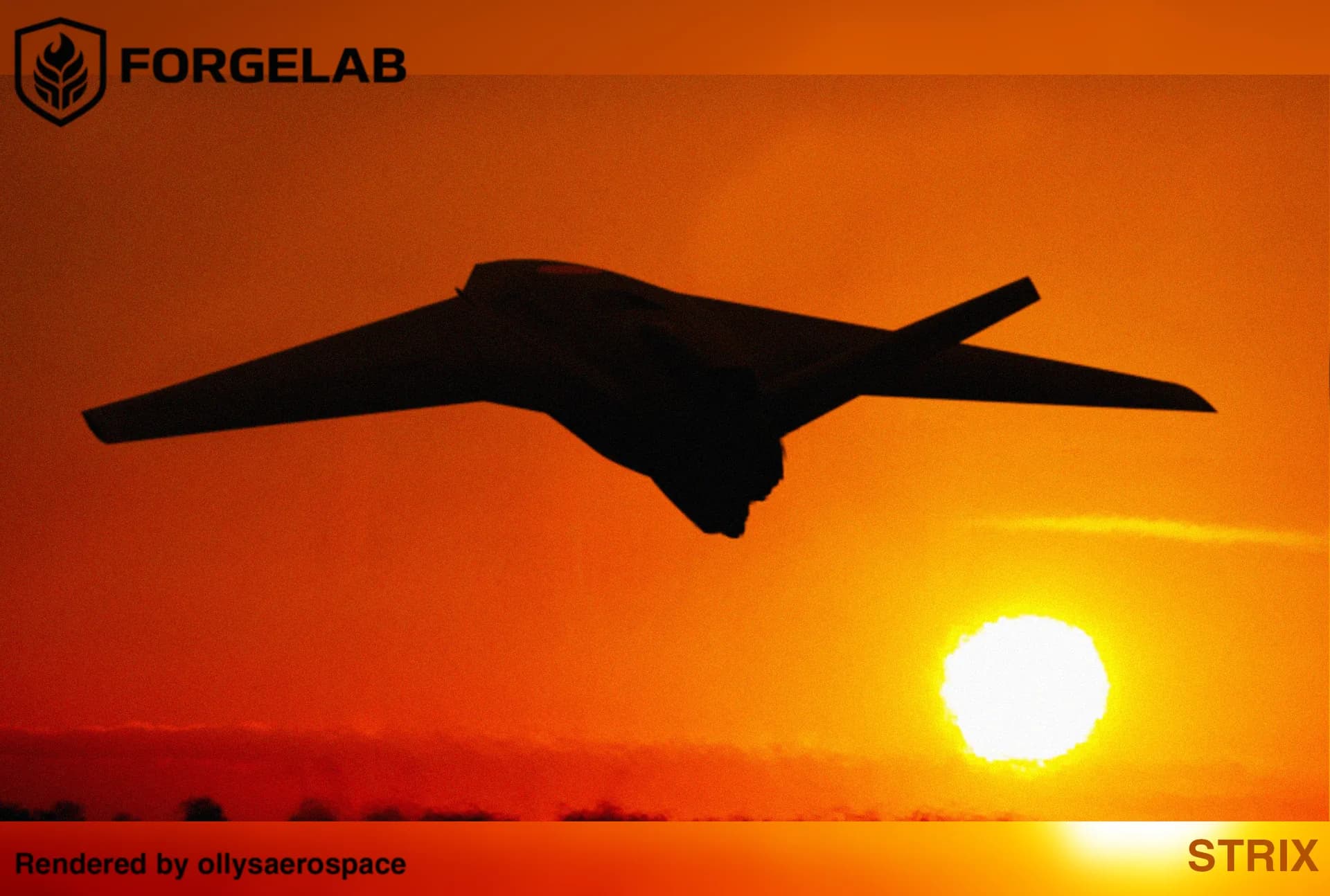
STRIX is being developed around a common payload bay and common interfaces, a modular aircraft designed to carry, power, and network mission payloads. That same modularity is what a candidate quantum payload needs: a defined mechanical, thermal, electrical, timing, and data envelope to integrate against.
The intended progression is deliberate: interface definition, laboratory integration, environmental hardening, ground and captive test, then airborne evaluation; each stage gated on evidence from the last.
The Stack
01
Candidate modalities under study; no payload integrated.
Candidate quantum sensing modalities. Selected, not invented, by DERECHO.
Airborne carriage, power, isolation, thermal control, and calibration environment.
03
Classical estimation today; quantum-derived inputs are a research vector.
State estimation and multi-sensor fusion at the edge, under human supervision.
Moving measurements, timing, confidence, and identity across a degraded mesh.
05
OVERWATCH
Ground / operator tier of the mesh architecture, in development.
Presenting confidence, uncertainty, and anomaly context a human can act on.
Extending timing continuity and relay concepts beyond the air layer.
Limitations
No quantum sensor has been integrated on, or flown on, a DERECHO platform. STRIX is not quantum-equipped, payload dimensions and capacities are not published, and no environmental-performance figures are claimed. What this page describes is the integration architecture DERECHO is developing so that candidate payloads can be evaluated honestly when they are ready.
Research and integration architecture. No quantum payload has been integrated or flown; descriptions on this page are design intent for systems in development.
Quantum sensing, quantum communications, quantum key distribution, quantum computing, and post-quantum cryptography are distinct disciplines. DERECHO's work in this area is research and integration architecture for systems in development; descriptions reflect design intent, and no quantum capability, performance, certification, or compliance is claimed.